
In the open, $200–$500
A visible, reachable burst, garden, garage, accessible wall, cut out and repaired at business-hours rates.
A burst announces itself somewhere convenient, a ceiling stain, a soggy lawn, and hides somewhere else entirely. We isolate the water, trace the line to the actual failure, and replace the broken section properly. Then it holds a mains-pressure test before a single surface closes. Brookvale and the Northern Beaches, day or night.
Pipes rarely burst without a biography. Brookvale’s older homes run copper laid generations ago, thinning quietly from the inside until mains pressure finds a weak micron; galvanised steel rusting at every thread; and renovation-era junctions where old metal meets nineties plastic meets modern PEX, each connection a wager against time. High street pressure across parts of the Northern Beaches settles those wagers early.
Then the water lies to you about the address. It runs the outside of the pipe, follows timber, and surfaces metres downhill of the failure: which is why opening the ceiling under the stain finds wet plaster and nothing to fix. We refuse to guess: the line is traced with listening gear, thermal imaging and section pressure testing, the failed piece is cut out, and the repair proves itself on a gauge before the plaster goes back on.


Homes of this period were built to be lived in rather than serviced. Pipework runs under floors with limited crawl space, through fibro sheeting that does not like being cut, and into slabs poured before anyone thought about access.
Much of residential Brookvale was built in the 1940s–60s on clay pipework that is now cracking and sagging, catching debris until the line stops flowing.
It is why locating a leak precisely matters more here than in a modern home, the cost difference between opening one square metre and opening a room is most of the invoice.
Brookvale is the industrial and retail hub of Sydney’s Northern Beaches (postcode 2100), spread across a valley floor between Dee Why, Manly Vale and the Allambie Heights ridge. Its mix of post-war homes, unit blocks and busy factory streets keeps drains under constant pressure.
In an apartment you generally cannot use the street meter, that serves the whole building. What you need is your lot's own isolation valve, usually in the laundry, a hallway cupboard, or a riser cupboard on your floor.
Find it on a calm evening and make sure it turns. A valve that has not moved in fifteen years sometimes will not, and discovering that at midnight with water running is a much worse time to learn it.
On sloping ground water leaves a failed pipe and travels, following the easiest path under the surface until something stops it. It can emerge metres downhill, in a neighbour's yard, or against a retaining wall.
Brookvale Creek collects runoff from the surrounding ridges, and in heavy rain the valley’s stormwater pits and pipes back up quickly, flooding yards and driveways.
So digging where the water appears is usually digging in the wrong place. Correlation and acoustic equipment work uphill from the symptom, which on a steep block routinely saves several metres of unnecessary excavation.
A cracked earthenware line under the yard can lose water into the ground indefinitely without a single visible symptom. The soil takes it, the grass over it looks slightly better than the rest, and nothing backs up because the line still flows.
The damage is not the lost water, it is what saturated ground does to footings and to the bedding under the pipe itself. A line leaking into its own trench undermines its own support, which is how a crack becomes a sag and then a collapse.
When an area went up as a single wave of building, its plumbing reaches the end of its life as a single wave too. Neighbours comparing notes about bursts in the same season are not imagining the pattern.
If houses either side of you have had pipework replaced, that is genuinely useful information about yours. It does not mean acting immediately, it means a burst in your house is a condition report rather than a surprise.
Water appearing through your ceiling is one of the few plumbing situations where the fault is definitely not yours and the damage definitely is.
Get the water isolated upstairs if anyone is home, photograph everything before it is touched, and notify the building manager in writing the same night. Our report names the source lot and the line, which is what your insurer and the owners corporation both need before anybody pays for anything.
A visible, reachable burst, garden, garage, accessible wall, cut out and repaired at business-hours rates.
Adds the tracing and the careful access: finding the true split before opening anything, so only one hole gets made.
Detection gear, concrete access or a reroute. Precision here is the whole cost battle, small hole, right place.
Roughly $180–$250/hr against $120–$160 daytime, plus call-out. With the meter off, morning is sometimes the smarter spend, we will tell you honestly.
Leak detection's first hour, locating the failure before demolition, reliably cheaper than exploratory holes.
Every repair ends the same way: holding mains pressure on a gauge, under a lifetime workmanship warranty. Figures here are indicative of the 2026 Sydney market rather than a quote from us, you get your own number as a fixed price before any work starts.
Meter valve clockwise: we walk you through it on the phone, and the flood stops before the van starts. On site we isolate just the injured line when the layout allows it.
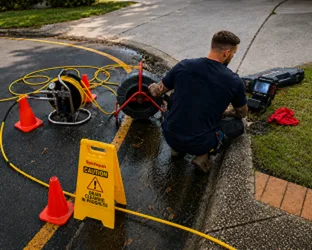
Acoustic listening, thermal imaging and section-by-section pressure testing find the actual split, which is rarely under the wet patch.

The damaged section is removed and replaced properly. If what we expose says the whole run is finished, you hear it straight, with prices for both roads.
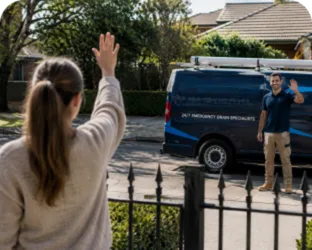
Mains-pressure test before anything closes. The repair demonstrates itself; then, and only then, do surfaces go back.
The hard part is done, the water has stopped. Call, and we plan the repair with you before anything else gets wet.
Traced with instruments, repaired once, proven under pressure: and priced before any of it starts.

Leave your details and our local Brookvale team will call you back fast.